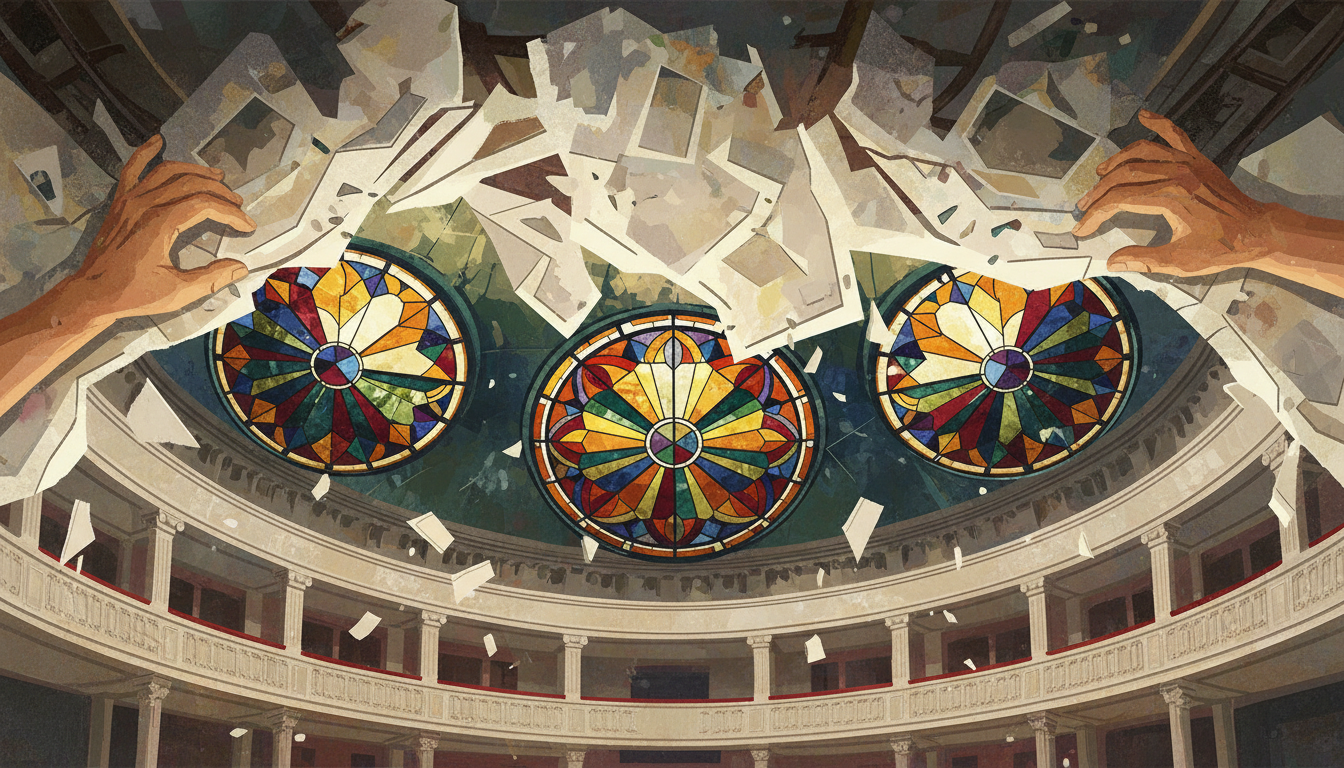

Removing a suspended ceiling can change the history a building is able to tell. At Espace Berlioz in Plombières-les-Bains, renovation work revealed three glass roofs signed by master glassmaker Jacques Gruber. They belong to the town’s former casino, a different building from the present Partouche venue on the site of the old railway station.
That distinction is central to the story. Casino heritage can remain embedded in a town after gaming has moved elsewhere. In this case, the discovery concerns a building whose subsequent life has included cinema, performances and civic gatherings.
What the ceiling concealed
The Fondation du patrimoine’s project page, updated in October 2026, reports that removing false ceilings exposed the three works in the east wing. Its restoration proposal names the Bassinot workshop in Nancy and envisages returning the glass to its position in the building.
The discovery adds both material and authorship to the room’s history. A signature provides a specific maker to investigate. The position of the glass shows how daylight was intended to enter the space. Restoring such work involves more than recovering an ornamental object: it can change the lighting and perception of the interior around it.
A cultural building after the casino
The municipality’s history of the old casino traces the building’s changing entertainment role and the decision to move casino activity to the former station. The Fondation’s account describes Espace Berlioz’s later civic uses, including events and performances. The building’s social purpose consequently extends beyond a single commercial identity.
This is a useful way to think about adaptive reuse. The name on the door can change while some patterns of use continue. A place where people once gathered for entertainment may retain that public significance through a cinema, cultural centre or event room. New needs can also cover older features, which later work may rediscover.
Restoration as a proposal for future use
The heritage project connects the glass restoration with plans for cultural spaces, including a room intended to present collections from the Musée Louis Français. These are described as future uses in the project documentation. The source does not establish that the restored glass or the completed new programme is already available to visitors.
The current casino’s website separately describes its location on the foundations of the old station. Keeping those two addresses distinct allows both stories to remain clear. One concerns a working casino in a reused transport setting; the other concerns the recovery of light, craftsmanship and cultural purpose in the building the casino left behind.
Related property: Casino Partouche Plombières Les Bains directory guide.
Leave a Reply